
I was reading a clinical paper on ketamine treatment for depression recently. It was a good paper — thorough, evidence-based, the kind of thing you’d hope to find if you were a clinician trying to understand what the research actually says. I was working through it with genuine interest.
However somewhere around the third section, I noticed something.
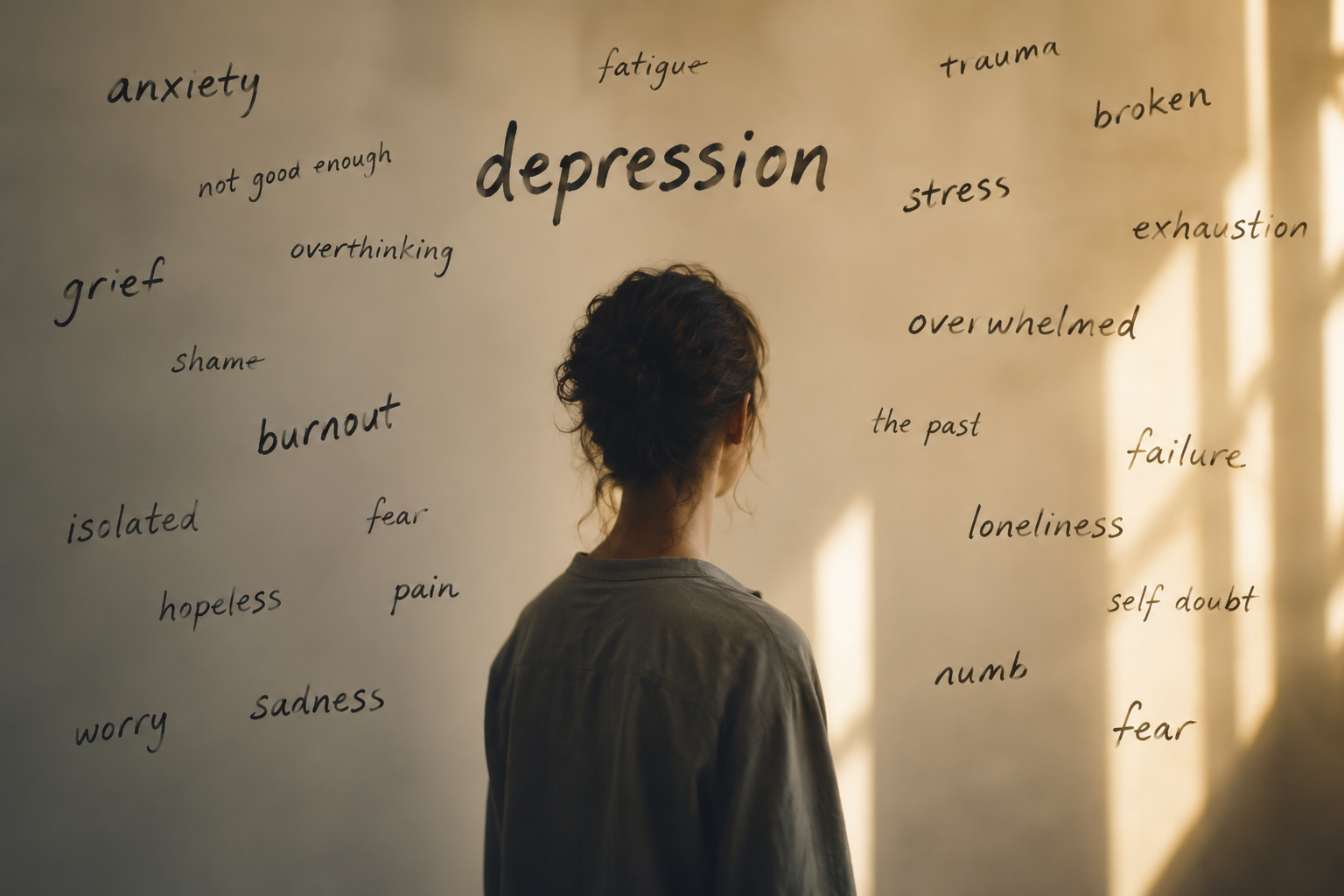
The paper was talking about depression. Carefully, rigorously, with real expertise. But it wasn’t talking about this person’s depression. Or that person’s. It was talking about depression as a category — a cluster of measurable symptoms, a set of outcomes, a diagnosis.
Which is exactly what research is supposed to do. I want to be clear about that. We need good research. We need to know what treatments work, for whom, and under what conditions. The evidence base for ketamine as a treatment for depression — particularly treatment-resistant depression — is growing in ways that are genuinely exciting, and that wouldn’t exist without rigorous clinical studies.
But sitting with that paper, I found myself thinking about the people I see every week in my therapy room in Gorleston-on-Sea. And I found myself thinking: the word “depression” does a lot of work, and sometimes it does too much.
The Problem With One Word
The diagnosis of depression is useful. It allows clinicians, researchers, commissioners, and patients to talk to each other about a shared set of experiences. It helps us identify when someone needs support, guides treatment decisions, and allows services to be organised and funded. Without diagnostic categories, mental healthcare would be harder for everyone.
However a label can also create the impression of understanding where understanding hasn’t quite arrived yet.
Think about two people sitting in a waiting room. Both have been diagnosed with depression. Both are struggling to get out of bed in the morning. Both score similarly on a standardised questionnaire. If you looked at their symptom profiles, you might not immediately see much difference.
Yet one is grieving. Her mother died eight months ago and she has barely been able to cry, because she was always the strong one in the family and doesn’t quite know how to stop.
The other has spent thirty years trying to be who everyone else needed him to be. He’s good at his job, reliable, well-liked. He hasn’t felt like himself in so long that he’s no longer sure who that would even be.
Same diagnosis. Completely different stories. Completely different lives sitting behind those identical questionnaire scores.
This isn’t a criticism of diagnosis — it’s a recognition of what diagnosis can and can’t do.

Diagnosis Versus Formulation
In psychological therapy, there’s an important distinction between diagnosis and formulation. It’s one that doesn’t always make it into public conversations about mental health, but I think it matters.
A diagnosis asks: what category best describes this person’s symptoms?
A formulation asks: how did this particular person come to experience these symptoms, in this way, at this point in their life?
Both questions matter. But only one tells a story.
Diagnosis helps us identify what is happening. Formulation helps us begin to understand why — and that “why” is usually where therapy lives.
If you’ve ever been given a diagnosis of depression and felt simultaneously relieved and oddly unsatisfied, this might be part of the reason. Relieved, because finally there’s a name for it. Unsatisfied, because the name doesn’t explain the heartbreak, or the exhaustion, or the slow accumulation of experiences that brought you to this point.
The diagnosis may be accurate. But it doesn’t capture the whole person.
How Do You Do Depression?
When I’m working with someone experiencing depression, I sometimes ask a question that tends to catch people off guard.
Not: “Do you have depression?”
Not: “How severe is your depression?”
But: “How do you do depression?”
The first time I ask it, people usually look at me as if I’ve said something slightly odd. Then there’s a pause. And then they start talking.
“My depression makes me go quiet. I just stop responding to people.”
“Mine tells me I’m a burden. That everyone would be better off if I just sorted myself out and stopped making it everyone else’s problem.”
“I think my depression is what keeps me so busy. If I stop, I have to feel it.”
“My depression makes me put everyone else first. I don’t even know what I want anymore.”
“It makes me stay in situations I know aren’t good for me, because at least they’re familiar.”
What’s happening in those moments is that we’ve stopped discussing a diagnosis and started discussing a relationship — specifically, the relationship this person has with their own suffering. We’re looking at patterns. At beliefs. At protective strategies that may have developed for very good reasons at some earlier point in life, but which are now, perhaps, doing more harm than good.
That’s often where meaningful therapy begins. Not at the diagnosis, but at the story inside it.

What Depression Is Often Protecting
Something I’ve noticed over the years is that people rarely describe depression purely as sadness. More often what I hear is: trapped. Exhausted. Numb. Invisible. Disconnected. Unable to be themselves.
Sometimes depression arrives alongside grief that hasn’t had room to be expressed. Sometimes alongside decades of suppressing anger because it never felt safe to show it. Sometimes alongside a life that, from the outside, looks entirely fine — which can make the whole thing feel even more bewildering and shameful.
Of course, depression also has biological components. Genetics matter. Neurochemistry matters. Physical health matters. Sleep, inflammation, stress hormones — all of it is relevant, and none of it should be minimised. This isn’t an either/or conversation.
Yet two people can have identical symptom scores while living in completely different emotional realities. And what they need from treatment may be quite different too. One person may need, above all else, symptom relief — to get out of the pit and back onto solid ground. Another may need to understand how they ended up in the pit in the first place, and whether there’s something about the life they’re returning to that keeps pulling them back toward the edge.
Most people need something of both.

Why This Matters For Treatment — Including Ketamine
If depression can develop through multiple pathways, it follows that different people may need different kinds of support. Medication helps many people enormously and can be genuinely life-changing. Lifestyle factors — sleep, exercise, social connection — matter more than we sometimes acknowledge. And psychological support remains important not just for symptom management, but for understanding.
This is one of the reasons I find ketamine-assisted psychotherapy (KAP) so compelling as an approach — and why I think the way it’s delivered matters just as much as the medicine itself.
The conversation around ketamine for depression in the UK has grown significantly in recent years, and rightly so. For people with treatment-resistant depression — those who haven’t found adequate relief through antidepressants, talking therapy, or both — the evidence for ketamine’s antidepressant effects is increasingly hard to ignore. The rapid reduction in symptoms that many people experience, sometimes within hours of treatment, can be remarkable.
That said what interests me most in my own clinical work isn’t only the symptom reduction, as significant as that is. It’s what often becomes possible in the space that symptom reduction creates.
Many people who undergo ketamine treatment describe gaining a different perspective on themselves — sometimes quite suddenly. They notice patterns they had been too close to see. They reconnect with emotions that had been inaccessible for years. They find themselves able to look at long-held beliefs — I’m unlovable, nothing will ever change, I don’t deserve good things — with a kind of distance they hadn’t previously been able to achieve.
In the ketamine-assisted psychotherapy model we practise at The Ketamine Clinic, the medicine is one part of a broader therapeutic process. The preparation matters. The integration work that follows each session matters. The ongoing relationship between client and therapist matters. The medicine may open a door, but it’s the therapeutic work that helps people walk through it and understand what they find on the other side.
People don’t just feel different. They often begin to understand themselves differently. And sometimes — not always, but sometimes — that shift in understanding becomes the foundation for something more lasting than symptom relief alone.
A Different Question
I am genuinely grateful for the science. We need it to keep developing. We need better treatments, better evidence, better understanding of who responds to what and why. The research into ketamine for depression, for treatment-resistant depression, and increasingly for conditions like PTSD and anxiety, is moving quickly and I find it genuinely exciting to be working in this field right now.
Even so, I also think we need to hold onto the person inside the diagnosis.
A person with a history. With relationships and losses and disappointments. With beliefs about themselves that formed long before they ever sat in a waiting room filling in a questionnaire. With things they’ve never said out loud that might matter enormously.
So if you’ve been diagnosed with depression — or if you’re wondering whether what you’re experiencing might be depression — perhaps there’s a question worth sitting with.
Not just: do I have depression?
But: how do I do depression?
How does it show up in my relationships? What does it convince me is true about myself? What does it stop me from saying, or asking for, or feeling? What role has it quietly come to play in my life?
After all, a diagnosis can tell us what is happening. But understanding how your depression operates — how you do it, the specific shape it takes in your specific life — that’s often where the real work begins.
And in my experience, it’s also where real change becomes possible.
Paul Gibson is a psychotherapist and Director of The Ketamine Clinic, based in Gorleston-on-Sea, Norfolk. The Ketamine Clinic offers ketamine-assisted psychotherapy for depression, treatment-resistant depression, PTSD, and anxiety. If you’d like to find out more, you can get in touch here.